
De Leopard‑2 vormt al decennialang de ruggengraat van de cavalerie. In dit artikel wordt ingegaan op de ontwikkeling, inzet en modernisering van deze Main Battle Tank. De combinatie van foto’s en toelichtende tekst laat zien hoe de Leopard‑2 zich heeft ontwikkeld van een opvolger van de M48/M60 tot een moderne, toekomstbestendige gevechtstank die door vele landen wordt ingezet.
Afb 01 – The Main Battle Tank Leopard‑2
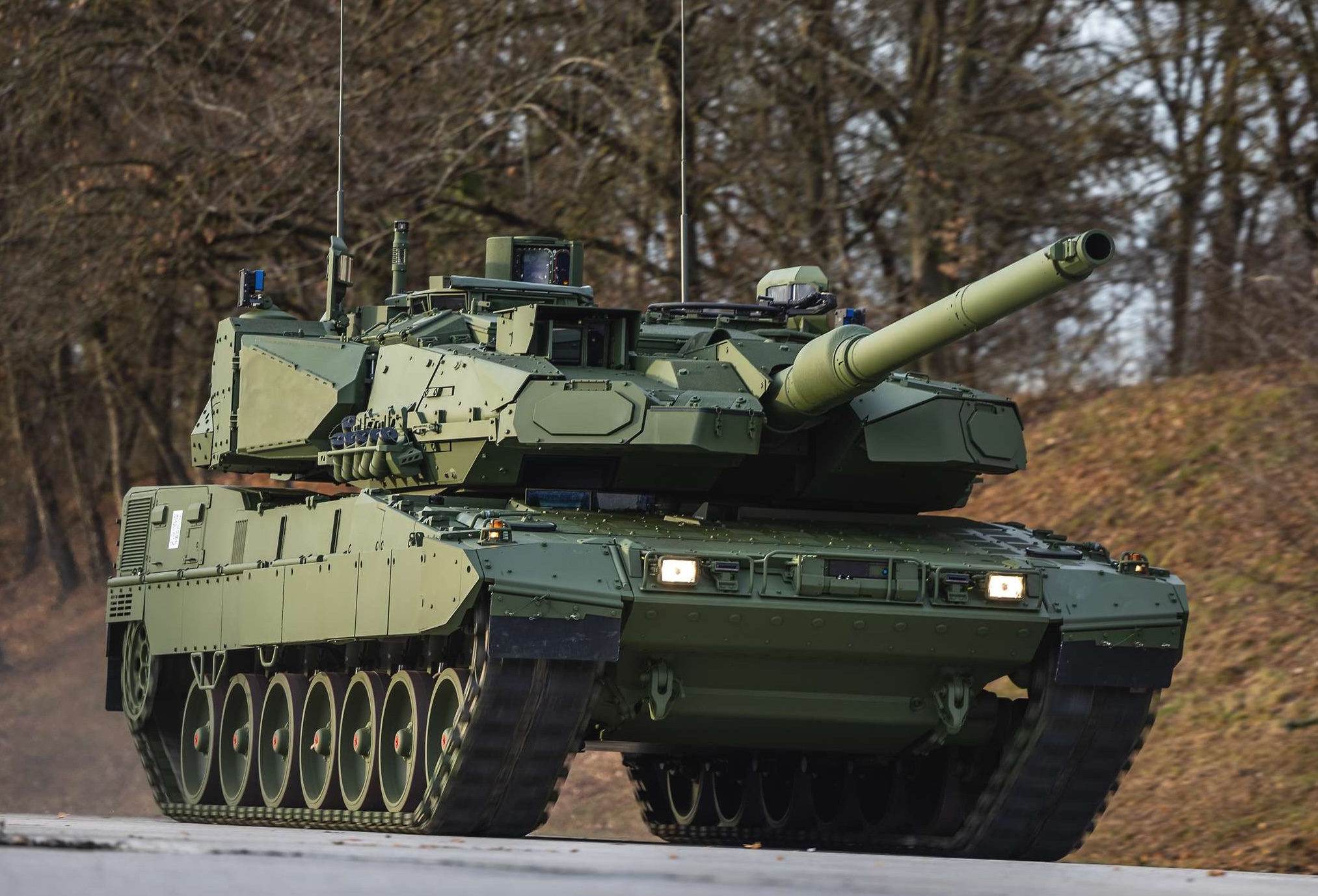
The main battle tank LEOPARD‑2
The past, today and forward into the future
Michael Beck – KNDS München
Preface
In a bilateral armaments project between the United States and the Federal Republic of Germany, a successor was sought for the M48 Patton‑II and M60 tanks, both of which were still in use at the time. In August 1963, the decision was taken to develop a standardized main battle tank (MBT) for the respective armed forces.
However, the project, known as MBT‑70, failed after a few years because the performance requirements were too high (firing at moving targets while on the move, weapon tracking, automatic loader, 20mm secondary weapon system, and the arrangement of the driver’s seat in the turret). Such requirements were far ahead of their time.
However, the results of the MBT‑70 program continued to be incorporated into national tank programs. The M1 Abrams was designed in the United States. The Leopard‑2, on the other hand, was developed in Germany. The requirements for the Leopard‑2 were derived from the MBT‑70 development program as well as from parallel considerations regarding the retrofitting of the Leopard‑1.
During development, experience gained during the Yom Kippur War (1973) and insights from the development of Russian main battle tanks were also incorporated. After numerous iterative steps and the construction of various prototypes, series production finally began in 1979. A total of 2125 Leopard‑2 MBTs were produced for the German Armed Forces alone in several batches.
Where does the Leopard stand today?
The Leopard‑2 main battle tank, the backbone of many land forces, celebrated its 40th birthday recently, as widely reported in the press. Nonetheless, the Leopard‑2A4 is still in service with some armed forces in its basic configuration; however, by today’s standards it offers only limited survivability against modern armed forces.
The Leopard has undergone several combat‑capability upgrades, the result of multinational cooperation at both military and industrial levels. This initiative was the result of strong alliances between the armed forces of various nations within the framework of ‘LeoBen’, the Leopard user club led by BAAINBw (Bundesambt für Ausrüstung, Informationstechnik und Nutzung der Bundeswehr – Koblenz).
Several working groups within LeoBen focus on utilization and logistics, as well as preserving and further developing the capabilities of the Leopard main battle tank. In particular, the experience gained with the Leopard‑2 in Afghanistan and industrial trials under the most extreme conditions were key milestones for further developments.
Afb 02 – 40th Anniversary Event
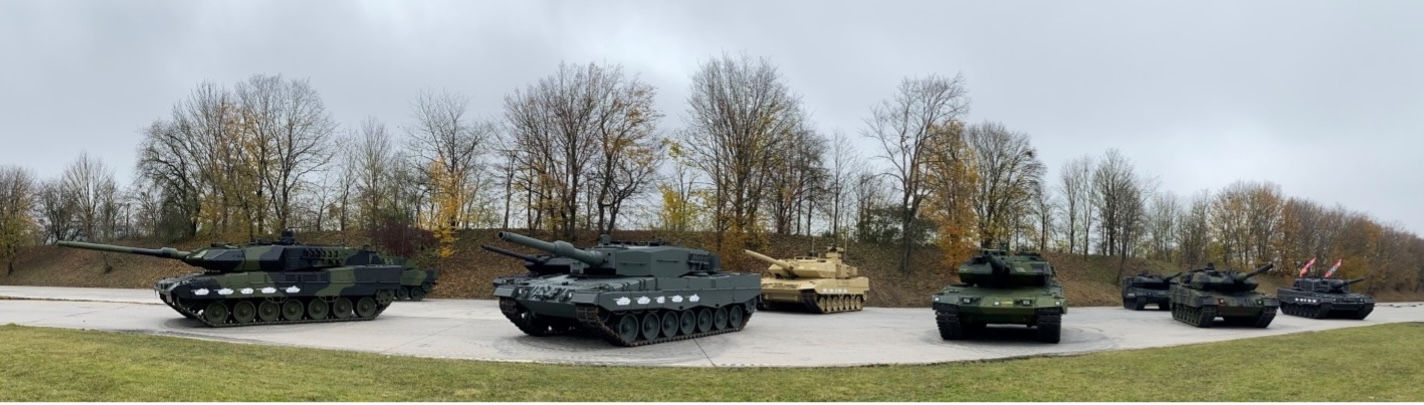
The 40th‑anniversary event for the Leopard‑2, featuring various user‑nation variants.
Just a few years ago, heavy combat systems were considered obsolete by Germany and other European NATO forces. However, this perception changed dramatically following the Crimea crisis and Russia’s invasion of Ukraine.
Even before this, numerous individual measures had already been taken to carefully modify the Leopard‑2 to adapt at least a certain number of units to the current operational situation. The war in Ukraine, particularly the transfer of various versions of the Leopard‑2 battle tank, has made the tactical and logistical consequences of different designs apparent. These consequences negatively impacted operational training, the supply of spare parts and ammunition logistics.
Afb 03 – Leopard‑2A7V
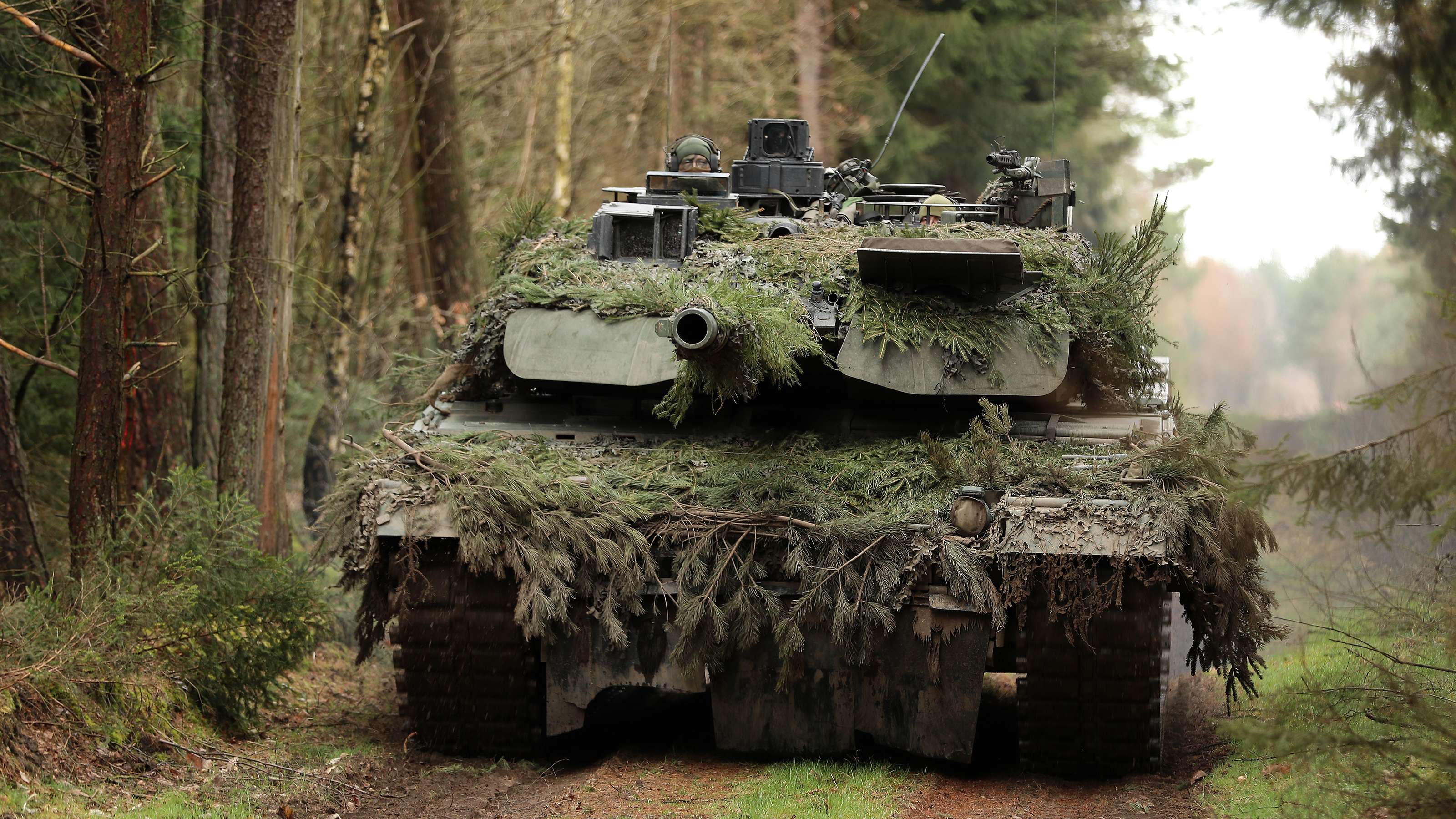
Various versions of the Leopard. Here the Leopard‑2A7V.
This gave rise to the idea of creating a largely unified logistics platform for the Leopard‑2 using modern technologies and digital structures: the birth of the Leopard‑2A8. The Leopard‑2A8 once again offers maximum standardization, which has a positive impact on training, deployment, and logistics.
The A8 variant features further improved protection against armored vehicles and anti‑tank weapons, enhanced reconnaissance and target designation, and improved internal and external communications, while maintaining high firepower, outstanding night engagement range, and agility on the battlefield.
The future of the Leopard‑2
The threat situation in Europe remains tense. The German Armed Forces has recognized the need to adapt its forces to the new situation and is investing in its armored units; other nations are likewise modifying their fleets.
The war in Ukraine has prompted many former Warsaw Pact countries to transfer their T‑72 tanks to Ukraine, and they are now introducing Western main battle tanks, in many cases the MBT Leopard‑2.
KNDS Deutschland is completely remanufacturing the Leopard‑2A8 for all new user countries. This clearly shows that even today, more than 40 years after the system was introduced, the Leopard‑2 can still be produced and existing fleets can continue to be supported.
In November 2025 the first two Leopard‑2A8 for Germany and Norway were presented to the world at KNDS Deutschland in Munich. Several more countries as the Netherlands (2028), Sweden, Lithuania, Czech Republic and Croatia will follow. With its capabilities in the areas of protection, firepower, endurance, data communication, and command and control in a mixed formation, the Leopard‑2A8 will remain the benchmark for decades to come.
Afb 04 – Leopard‑2A8
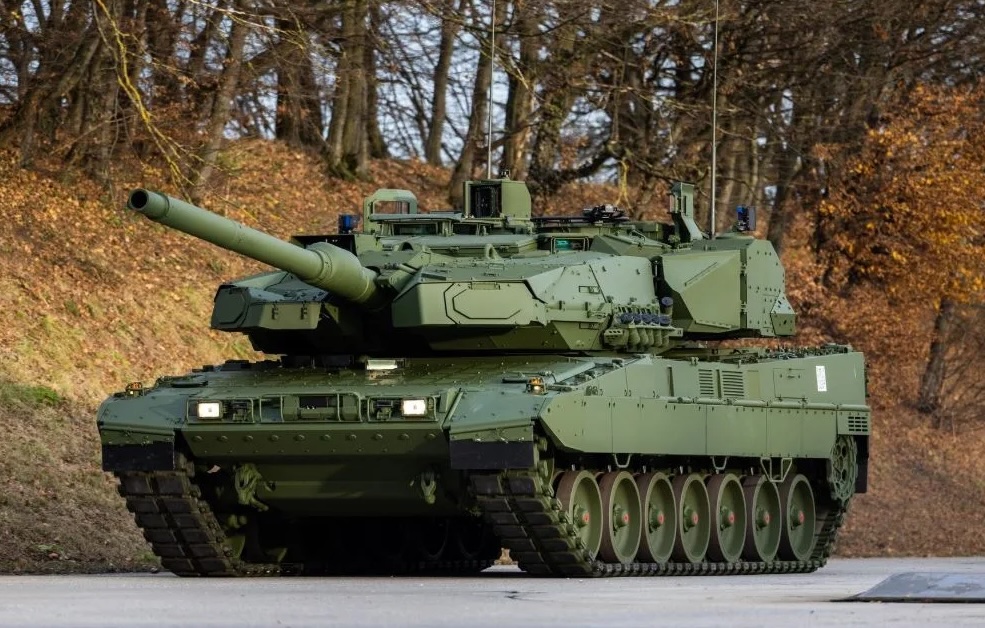
The first Leopard‑2A8 for Germany.
The future of the main battle tank
The main opponent of a main battle tank is the enemy main battle tank. It can be questioned whether this statement is still valid today. The threat from the air and in particular from hand‑held anti‑tank weapons and guided missiles has increased significantly.
The danger posed to main battle tanks by this type of threat was evident during the Turkish Armed Forces campaign in Syria. However, this was exacerbated by a lack of combat experience and inadequate protection of stationary field posts.
An expanded threat from the air then emerged in the war over Nagorno‑Karabakh and most recently in Ukraine: the threat from military and civilian drones equipped with hollow charges. This threat can only be countered — if at all — by hard‑kill active protection and/or enhanced roof protection.
Afb 05 – ATGM‑aanval in Oekraïne
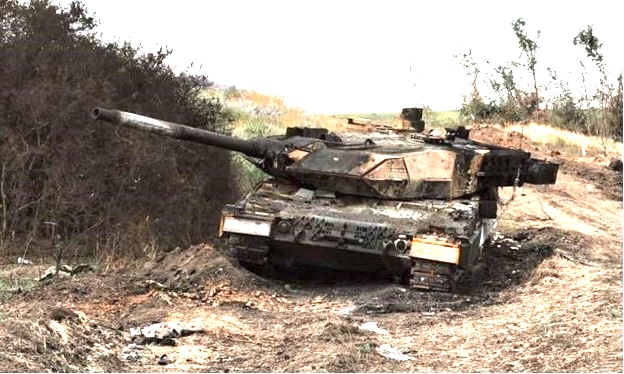
Losses from an anti‑tank guided missile attack in Ukraine.
In the past, the introduction of hard‑kill active protection systems in Germany was highly controversial. These protection systems were used extensively for the first time in the Infantry Fighting Vehicle Puma in the form of a soft‑kill system. With a potential deployment as part of alliance defense on NATO’s eastern flank, the threat situation was analyzed again and the need for protection against long‑range anti‑tank guided missiles was recognized. The hard‑kill Active Protection System (APS) Trophy further improves the protection of the Leopard‑2.
Afb 06 – APS Trophy
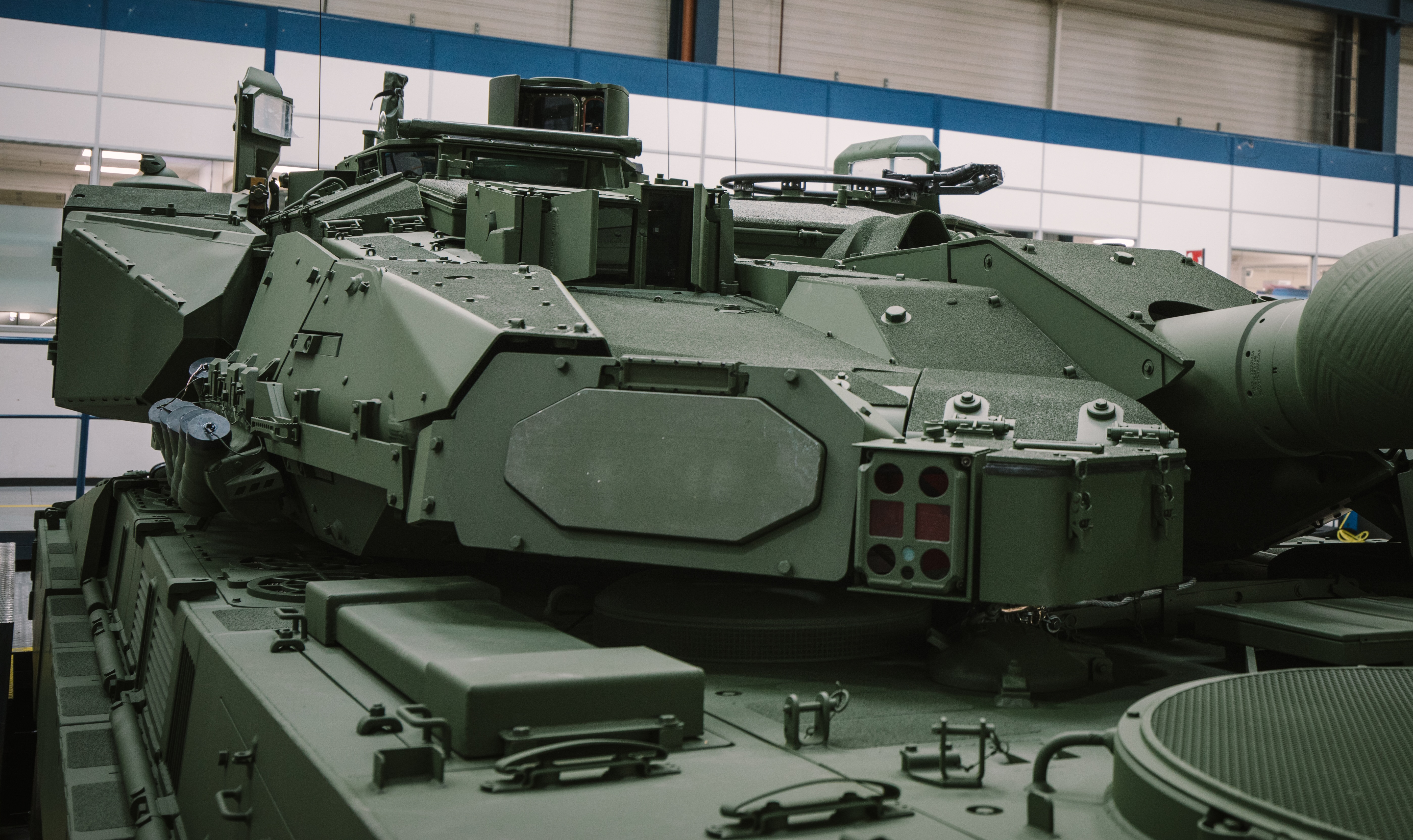
The hard‑kill Active Protection System (APS) Trophy.
Future development of main battle tanks
The magic triad of firepower, protection, and mobility continues to apply to armored tactical vehicles. In recent years, this triad has been supplemented by the parameters survivability/sustainability and communication/leadership — keyword: C4I. Partial aspects of survivability/sustainability are automated monitoring and reconnaissance with the triad of discovery, detection, and identification.
The demand for significant weight reduction, combined with increased firepower and greater range, makes it clear that this cannot be achieved using a single platform. Instead, the focus is now shifting to the concept of a main battle tank system: a platform with associated “satellites” that share the various requirements and fight in concert. These system components must be built on standardized platforms for logistical reasons.
As drones can now reach greater reconnaissance ranges than ever before, it is important to consider not only line‑of‑sight (LOS) detection and identification capabilities, but also non‑line‑of‑sight (NLOS) capabilities.
Main Ground Combat System (MGCS)
These new demands have been and continue to be the focus of numerous studies and research projects. The most prominent example is the MGCS study, in which Germany and France plan to develop a new Main Ground Combat System to succeed the Leopard and Leclerc.
As the lead nation in the MGCS program, Germany has set up a German‑French project team under German leadership within BAAINBw. Representing industry, the “MGCS‑Project Company GmbH” (MPC) was founded by KNDS Deutschland, KNDS France, Rheinmetall, and Thales SIX GTS France. The company is headquartered in Cologne.
MPC will be the contractor for a 4‑year technology demonstration phase (2026–2030). This multi‑year initiative is necessary to implement the multi‑platform concept favored by both nations. A network of individual platforms with different combat roles is planned. Networking, automation and robotics will be key parameters of the MGCS, in addition to the planned mix of weapons with direct and indirect effectors. Various technology demonstrators are planned during the demonstration phase. The launch of a production series is not expected before 2040.
MARTE – Main Armored Tank of Europe
Under the European Defense Fund (EDF), a tender was launched for the design of a European main battle tank system. KNDS Deutschland and Rheinmetall participated in this tender and formed the MARTE consortium (MARTE‑ARGE), comprising almost 50 European companies from 10 countries.
The goal in 2025 and 2026 is to define requirements that describe a joint European main battle tank concept. Potentially, this could bridge the gap between the available main battle tank solution (Leopard‑2A8) and the future solution (MGCS).
While MARTE is being pursued as a European project, Germany — as the leading tank development nation — additionally pushes the idea of bridging the gap between Leopard‑2A8 and the MGCS. Therefore, KNDS Deutschland is cooperating with its partners to define a possible successor of Leopard‑2A8.
As a technology demonstrator, KNDS Deutschland unveiled in 2024 the Leopard‑2 A‑RC 3.0. It is based on a chassis with a crew of 3 and a remote‑controlled turret without a basket or any soldier. Depending on national requirements, it is intended to integrate a 120 mm, 130 mm or 140 mm barrel. Furthermore, the system features a 30×113 mm cannon to counter additional ground or air targets.
Afb 07 – Leopard‑2 A‑RC 3.0
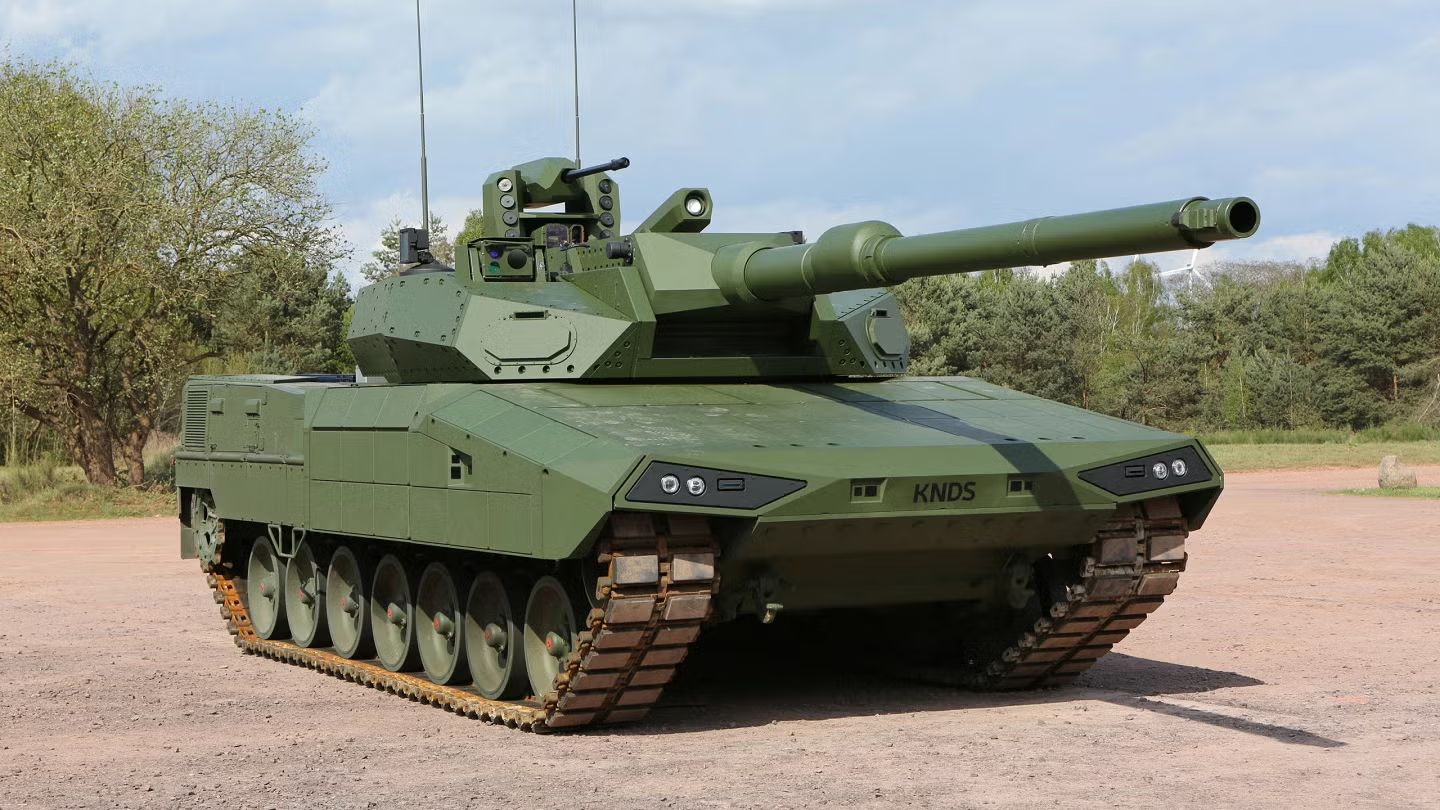
The Leopard‑2 A‑RC 3.0.
Outlook
With the transition to new manned and unmanned systems, the era of manned turrets on main combat systems is coming to an end. Using new technologies, the crew will be located in a protected cell and operate the weapon carrier from within the hull. Alternatively, the platform and its weaponry can also be operated completely remotely or autonomously.
The Leopard‑2 battle tank will definitely remain in service until the middle of this century. The system will be adapted to meet new challenges and continuously upgraded by the Leopard User Club (LeoBen) until the introduction of the new generation of main battle tanks.
Afb 08 – Leopard‑2A8 (Nederland)
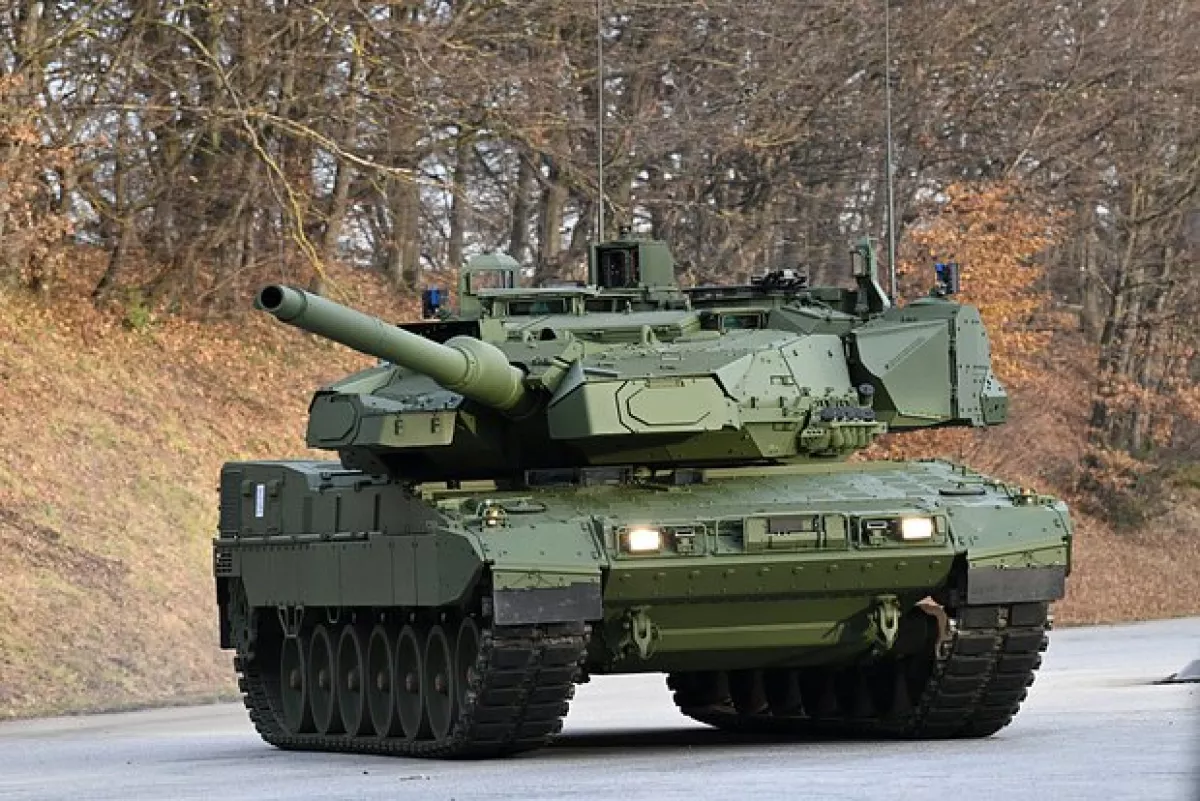
The Leopard‑2A8 for the Netherlands Army with the Active Protection System.
Jaargang 2026